
The Case for Local Flour
What industrialized flour took from bread, and what local mills are (thankfully) putting back

I work a 9-5 in corporate America (for now), but I start almost every single day standing in my kitchen with a bag of local flour and a vague sense of inspiration from a smell or flavor I’ve been exposed to that week and the seeds of an idea.
This is my happy place - before the tabs start to multiply, before my inbox starts flooding, and before the day turns into a smorgasbord of little digital indignities.
Flour on the counter and half-formed thoughts about what it could become is my 7am. Muffins, biscuits, cookies, something with rye, maybe a loaf with the last of the ricotta. The more I bake and cover both my kitchen and my sleep clothes with gritty, hearty real grain, the more I think flour is one of the clearest examples of what industrial food has taken away from us.
Now I didn’t set out to become a girl that talked about flour all the time. In fact, quite the opposite.
I generally spend my time planning travels to far-fetched places, staring at my Outlook inbox, running around in nature or scheming/executing on future business ideas - one of which, yes, has become owning my own regenerative farm and B&B.
But somewhere in the byline of the trips across Slovenia, France, Italy, the Nordics, I started noticing that the breads, pizzas and pastries I loved most all seemed to share a particular quality: they tasted like the earth, and real grain. Not “whole grain” in the original, punishing, virtuous way it started, but grain in the sense of depth of flavor, sweetness, warmth. The crust had color, texture, and would crackle and blister. The crumb had a different quality. Even the simplest slice of fresh sourdough paired with a local butter could send me into another dimension entirely.
Once I had this realization, I started tracing it backwards.
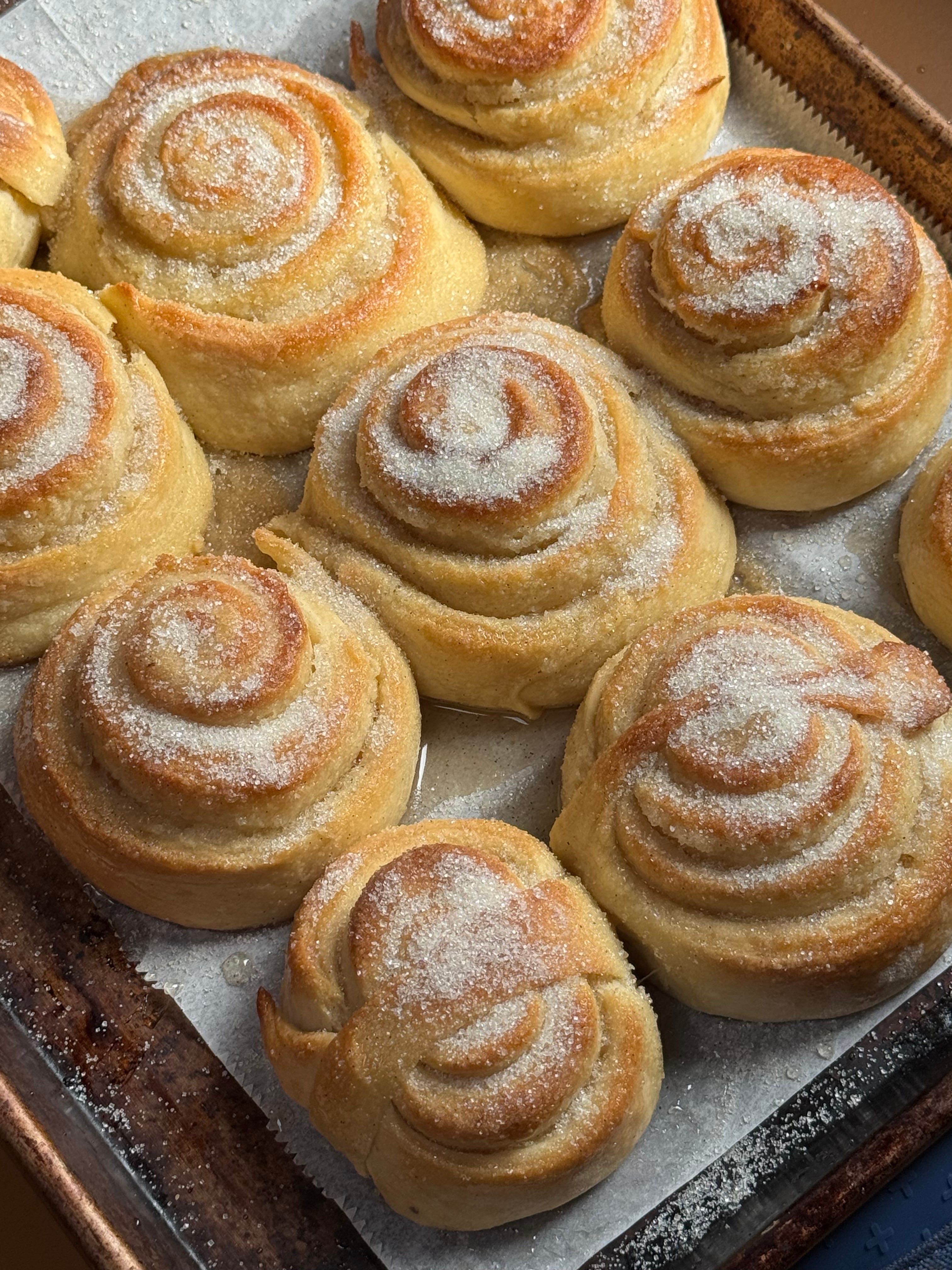
And again and again, the answer was: flour.
Many of the best bakeries today are already using local or regional flour, often fresh-milled, often whole-grain, and usually from mills and farmers who you can actually get to know like a friend. Once I started baking with these flours at home, I was done for. Grocery store refined, bleached Pillsbury started to create a certain type of repulsion. Why the heck would we actually remove the goodness, only to try to artificially put it back in later? It just didn’t make any sense. I don’t want a shelf-stable version of something that used to be alive.
For the last century, we’ve treated flour as a commodity. Our goal has been to make it whiter, finer, more stable, easier to transport, easier to standardize, “easier” to bake with. Some real industrialized nonsense, if you ask me, with sameness as the top prize. Roller milling made it easy to separate the bran and germ from the endosperm and scale the white flour to numbers that made sense - commercially, that is.
But as a consequence, we stripped it of everything that actually made grain worthwhile.
The bran and the germ are where much of the fiber, oils, minerals and flavor live. When you remove them, you get a predictable flour. Predictably boring, if you ask me. Life isn’t meant to be predictable, so why are we so insistent on making it so? Is this really all that life is anymore? Industrialized everything?
Our flour has fallen flat. It’s devoid of nutrition, sensation, that rich nutty smell that used to make it worth eating. So our country solved the problem in the only genius way they could devise: by adding nutrients back in. Because that makes perfect, complete, logical sense.
Let’s strip all of the nutrients out, and then add back in iron, B vitamins, folic acid. Then address all of the nutrient deficiencies later on.
This is not the same as keeping the grain intact in the first place and it’s a shame anyone ever pretended like it was.
Local flour isn’t just more romantic, it can be nutritionally different too. One recent small mill study out of Maine found notably higher fiber, calcium, and iron in freshly milled local flour compared with standard database comparisons.
But what that proved was that flour matters. Ingredients matter.
We can rationalize our way out of it all we want, but the difference is profound, in all ways.
The dough itself kneads differently. It absorbs more water. It has a fragrance. It browns more deeply. Working with this dough every morning has made me feel connected to the Earth, and also helped me realize that my favorite local bakeries aren’t holding out on me, they’re just working with better flour that has more flavor to begin with. They are starting with the right ingredients, ones that haven’t been processed into infinity.
This is why the regional grain story and supply chain is so darn critical.
A farmer can grow beautiful wheat, and a baker can want to use it, but if there is no mill, no storage, no distribution channel, no local infrastructure to actually turn the crop into flour, then the entire system dies.
Grain belongs to a place, after all. The flour in your kitchen should have a climate, a miller, a particular field that you can trace it to.
We’ve grown so accustomed to the bleach white paper bag that sprays flour to the heavens and beyond when you open it, the one with absolutely no depth or soul.
“How did we get so far away from real food?” I ask myself every time I open my locally-milled bag, occasionally with tears in my eyes.
I like knowing where my flour comes from. I like trusting the supply chain. I like shorter distances between my farm and mill and kitchen. I like traceability. I like the fact that I can tell you the names of the mills I buy from and in many cases, tag my favorite miller on Instagram to show them the buttery delicious result.
In a food economy that feels like it rewards vagueness without friction, I find the specificity - the simplicity - of it all to be deeply calming.
As a health nut and former biologist who has endured a few years of brutal chronic illness, I also would be remiss if I didn’t talk about the whole gluten intolerance thing.
Americans love talking about the pastries they ate overseas and then declaring themselves “gluten intolerant” here at home, as if the grain we’ve been eating for centuries suddenly became intolerable to humankind.
I’ve been down this path, so I get it.
And obviously some people can’t tolerate gluten: celiac disease is real, wheat allergies are real. None of this is meant to steamroll medical realities.
But I also think a lot of what people are reacting to is the ultra-refined, fast fermented, glyphosate-laden, additive-filled, form of flour that makes up our modern bread. We have completely eliminated everything good from our “bread” and then we act surprised when our bodies hate it. Is it really that surprising?
I firmly believe it’s the processing, not the grain itself.
(And don’t get me started on the physical health manifestations of glyphosate which is unequivocally found in nearly every single food product in America today. Make no mistake about my position: local flour is public health.)
So you’ll start to understand: this is why I keep ending up back at the mill.
The books on my table lately, Grain by Grain by Bob Quinn and Liz Carlisle and The Miller’s Daughter by Emma Zimmerman, further bolster my view. They are both arguing, in their own way, for the same restoration of our grain culture - not as a commodity, but as a place, flavor, and connection back to the land.
If I can challenge you to do one thing today it’s this: go hunt down a bag of flour from a local mill. If you don’t know of one, go to your favorite bakery and ask them what they use. I can almost guarantee it’ll be something real. Follow the crumb trail.
I’m based in Seattle, and my current rotation includes Cairnspring Mills (they just became the first flour company to earn the climate label cert!), Smalls Family Farm, Fairhaven Mill, Bluebird Grain Farms, Chimacum Valley Grainery, and a few others in the PNW grain orbit.
There are more. There should be more. I want there to be MANY more.
Local flour is one of the simplest ways to take it all back. Let’s declare war on homogenized flour, and demand they give us back our pastries.